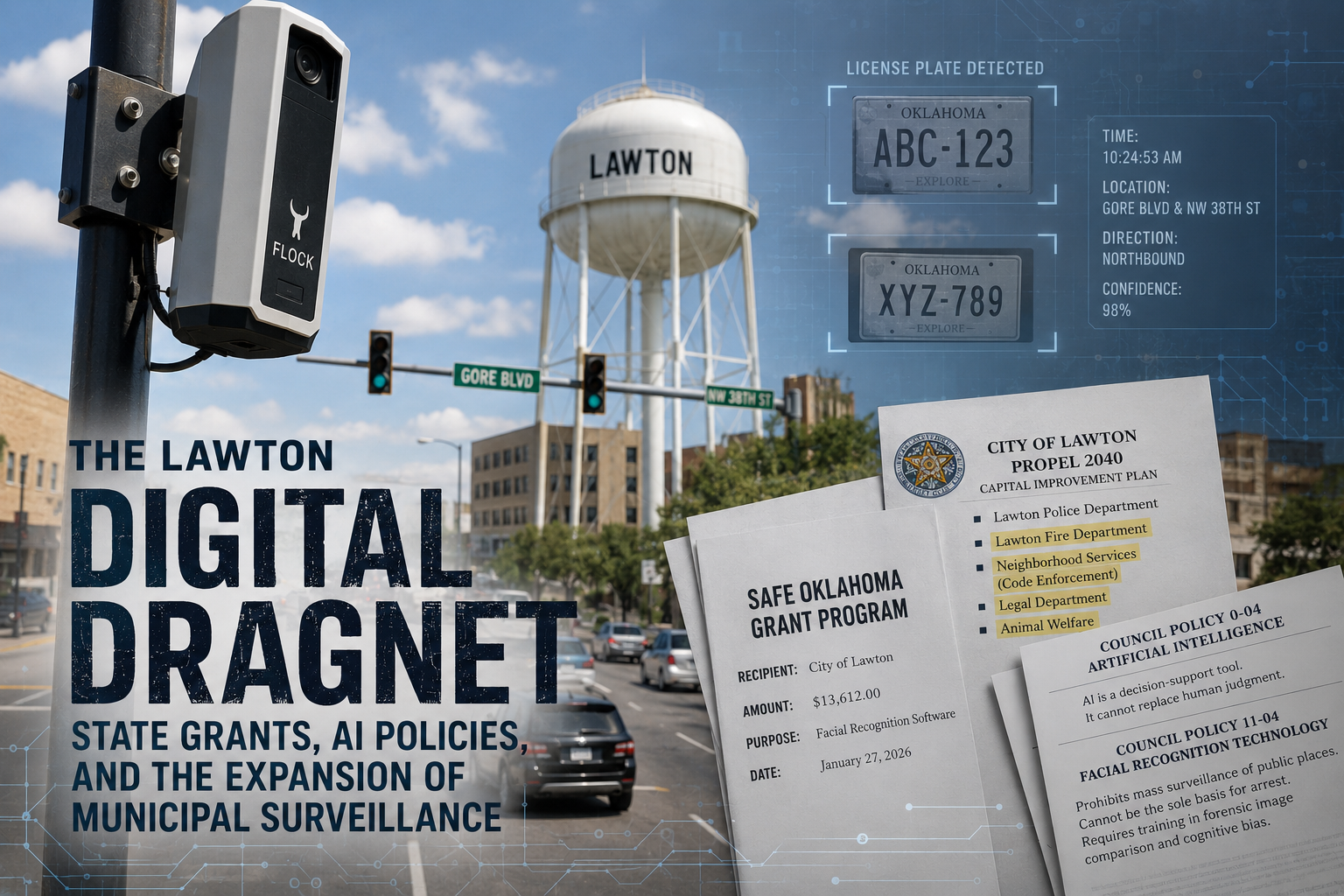
Lawton, Okla. — Following the rollout of Flock Safety automated license plate readers (ALPRs), city planning documents, public records, and recent policy actions indicate that Lawton is building an increasingly interconnected digital surveillance ecosystem—one that includes automated vehicle tracking, facial recognition technology, and future digital evidence integration.
But City Manager John Ratliff says some interpretations of the city’s long-range planning documents overstate current operational reality.
In written responses provided to the Lawton Town Crier, Ratliff emphasized that surveillance access remains tightly restricted.
“Departments outside of law enforcement do not have access to the City’s Flock Safety system or facial recognition technology software. At this time, there are no plans to expand access beyond authorized law enforcement personnel.”
He further stated:
“While Flock does offer additional tools related to traffic analytics, the City does not currently utilize or subscribe to those services and has no plans to do so.”
And regarding data sensitivity:
“Due to the sensitive nature of the information collected through license plate reader technology, access is intentionally limited to ensure compliance with policy requirements and appropriate use standards.”
Those statements offer important operational context.
They do not, however, fully resolve broader questions raised by public planning materials and recent technology acquisitions.
From Standalone Tools to an Integrated System
The City of Lawton’s PROPEL 2040 capital planning framework outlines a broader modernization effort involving surveillance systems, technology integration, and consolidated digital evidence infrastructure.
Modern law enforcement technologies increasingly operate as interconnected systems rather than isolated tools.
Automated license plate readers can generate searchable vehicle movement histories.
Body cameras and dash cameras can create synchronized video records.
Dispatch and records platforms track units, calls, and incident metadata.
Facial recognition systems can generate investigative leads.
Together, these systems can create a substantially more expansive digital evidence ecosystem than any one technology alone.
The city, however, maintains that current operational use remains narrower than some planning documents might suggest.
Facial Recognition Enters the Picture
On January 27, 2026, the Lawton City Council approved a $13,612 grant through the Oklahoma Attorney General’s Safe Oklahoma Grant Program for facial recognition software for the Lawton Police Department.
During the April 14, 2026 council meeting, officials confirmed the software vendor: Clearview AI.
Officials publicly stated that any software-generated match is treated only as an investigative lead—not probable cause—and requires independent human verification.
That position aligns with the city’s later policy framework. Clearview’s public policy is archived at our local wiki site. Clearview AI Policy
The Funding Question
Public records indicate:
- Grant funding: $13,612
- Estimated annual software cost: approximately $28,500
That leaves a substantial funding gap.
The unresolved question is whether the city intends to:
- absorb the difference through local budget allocations
- seek additional grants
- renegotiate pricing
- scale deployment differently
Planning Documents Raise Scope Questions
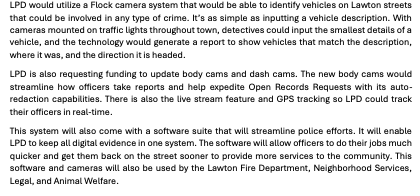
The PROPEL 2040 framework references a broader municipal technology ecosystem involving:
- Lawton Police Department
- Lawton Fire Department
- Neighborhood Services / Code Enforcement
- Legal Department
- Animal Welfare
Taken at face value, that language suggests a wider surveillance footprint.
But Ratliff directly disputed that interpretation.
“Departments outside of law enforcement do not have access…”
That distinction matters.
The planning framework may reflect conceptual future planning, vendor capability mapping, or broader modernization discussions—not necessarily current implementation.
Still, questions remain.
If broader access is not planned, why are non-law-enforcement departments included in the planning framework at all?
That question remains unanswered.
Policy Guardrails
On April 14, 2026, the City Council adopted two policy frameworks.
Council Policy 0-04 — Artificial Intelligence
The policy defines AI as a decision-support tool, not a replacement for human judgment.
Departments using AI-assisted outputs must attest to their truthfulness and accuracy.
The policy explicitly acknowledges that automated tools can produce inaccurate or misleading outputs.
Council Policy 11-04 — Facial Recognition Technology
This policy prohibits:
- facial recognition for mass surveillance of public places
- facial recognition as the sole basis for arrest
It also requires:
- forensic image comparison training
- cognitive bias awareness training
These policies establish meaningful boundaries on paper.
But public confidence depends on enforcement—not merely policy language.
The Oversight Question
Ratliff emphasized that access is restricted because of the sensitivity of collected information.
“Access is intentionally limited to ensure compliance with policy requirements and appropriate use standards.”
That statement addresses operational intent.
But several governance questions remain:
- Who audits compliance?
- Who reviews query logs?
- How are misuse allegations investigated?
- Are independent audits conducted?
- How are false positives documented?
The policies appear to rely primarily on internal compliance structures.
That does not establish misuse.
It does establish the need for transparency.
The Grant Incentive Loop
Internal records obtained through open records requests (Public Records Request of October 16, 2025, Reference # R001681-10162) indicate officers were instructed to document outcomes within the Flock platform—including arrests and contraband recoveries.
Those records indicate the reporting helps satisfy grant requirements and support future funding justification.
That creates an institutional incentive structure in which measured system “success” can support future expansion.
This does not invalidate operational results.
But it does raise legitimate public oversight questions.
Toward a Unified Evidence Ecosystem
Separate records indicate the city continues building toward broader digital evidence integration involving:
- Tyler Technologies “New World” dispatch / RMS infrastructure
- automated vehicle tracking systems
- Axon modernization
- centralized evidence workflows
Ratliff’s response makes clear that current operational access remains constrained.
But technology architecture often outlasts present policy choices.
The larger governance question is not merely how systems are used today.
It is how they could be used tomorrow.
Final Observation
Lawton’s current surveillance posture exists at the intersection of policy safeguards, expanding technology capability, and evolving governance expectations.
Ratliff’s statements provide important assurance that access remains restricted and current usage is narrower than some public planning language may imply.
At the same time, planning documents, grant funding mechanisms, and expanding technical integration raise legitimate long-term public accountability questions.
The issue is not whether technology should exist.
The issue is how transparently, narrowly, and accountably it will be governed.
Transparency & Methodology
This report is based on publicly available city planning documents, City Council meeting materials, policy documents, publicly discussed council actions, and records previously obtained by the Lawton Town Crier through Oklahoma Open Records Act requests.
To ensure fairness and accuracy, the Lawton Town Crier sought comment from the City of Lawton regarding policy scope, access controls, budgeting, oversight, and long-term implementation. City Manager John Ratliff provided written responses, which are quoted directly in this report where relevant.
This article distinguishes between current operational use, as described by city officials, and broader long-range planning concepts reflected in public planning documents.
The Lawton Town Crier has not alleged unlawful conduct by the City of Lawton or the Lawton Police Department. The purpose of this reporting is to document publicly disclosed technology deployments, governance policies, funding mechanisms, and unresolved public accountability questions surrounding expanding surveillance capabilities.
As with all investigative reporting by the Lawton Town Crier, documentary records are prioritized over speculation, and official responses are included to provide context and balance.
Click here to go to Part 2 https://lawtontowncrier.com/2026/05/lawtons-digital-guardrails-city-details-oversight-for-facial-recognition-and-surveillance-technology/