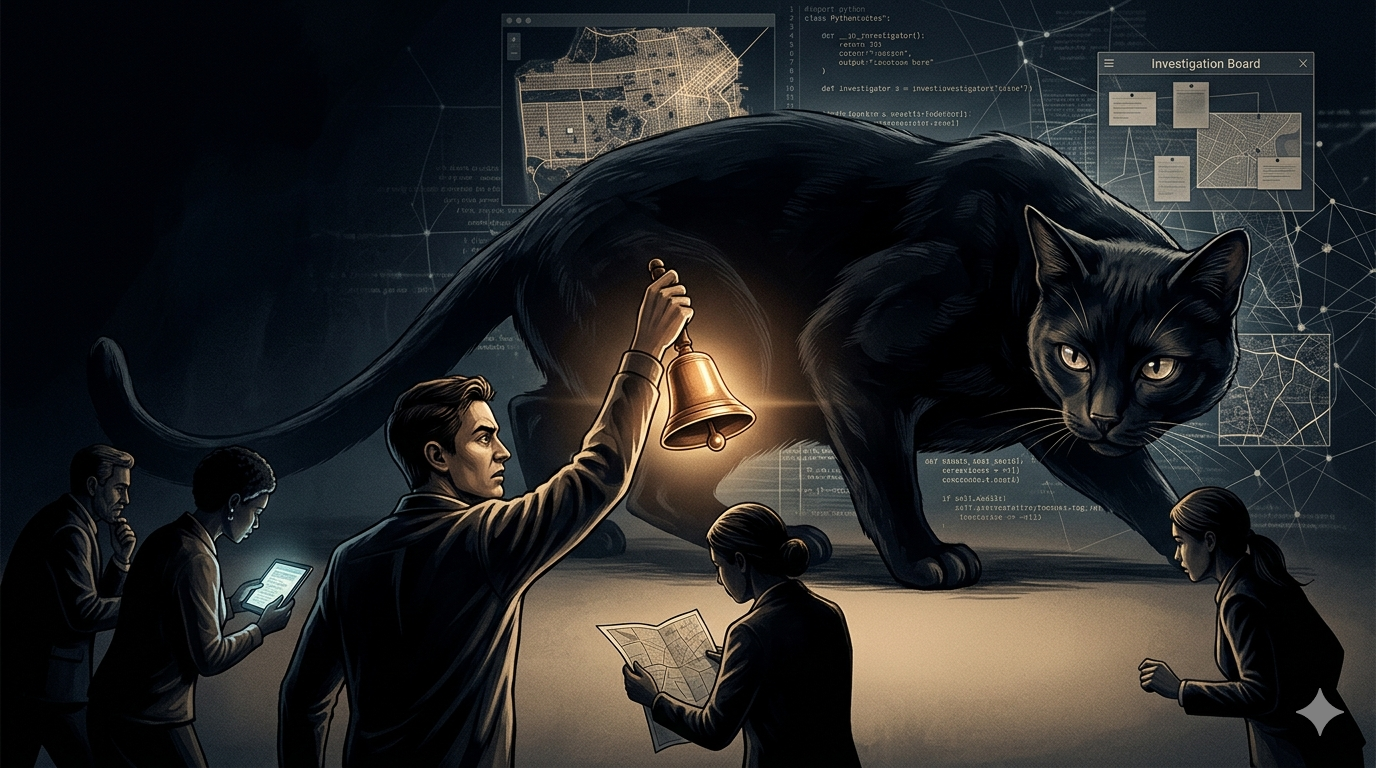
In the quiet corners of the 14th-century fable, a council of mice gathers to solve a lethal problem. Their nemesis, a sleek and predatory cat, has been picking them off one by one. The mice are clever, but they are small. The solution proposed is brilliant in its simplicity: they will hang a bell around the cat’s neck. The sound would provide a constant warning, a signal of transparency in a world of shadows. The plan is met with thunderous applause until one old mouse stands up with a chilling question: “But who will bell the cat?”
For decades, that question was answered by a handful of massive, legacy media institutions. They were the ones with the budgets, the legal teams, and the access to walk into the halls of power. But as the 21st century dawned, the “cats” grew more complex. Power became decentralized, digital, and increasingly adept at hiding in plain sight behind walls of state-sponsored propaganda and encrypted disinformation. The old guard was struggling to keep up with predators that moved at the speed of light.
Then came the outsiders. They didn’t have press credentials or corner offices. They had high-speed internet connections, an obsessive attention to detail, and a belief that the truth wasn’t hidden in a locked safe, but scattered across the public web in thousands of tiny, digital shards.
The Brown Moses Beginnings
In 2011, Eliot Higgins was not a journalist. He was an office worker with a penchant for online forums and a deep skepticism of official narratives surrounding the Arab Spring. Writing under the pseudonym “Brown Moses”—a name lifted from a Frank Zappa song—Higgins began doing something that seemed, at the time, like a hobby: he watched YouTube videos. Thousands of them.
As the Syrian Civil War escalated, Higgins noticed that the weapons being used in the footage didn’t match the descriptions provided by official government sources. While traditional reporters were struggling to get onto the ground in a war zone, Higgins was identifying Croatian M79 rocket launchers and Heat-1 rockets by comparing graining video frames with weapon manufacturer catalogs. He wasn’t on the front lines, but he was seeing the war with more clarity than those who were.
“I began to realize that the information was all there,” Higgins would later reflect. “It just needed someone to look at it, verify it, and put the pieces together.”
This was the birth of Bellingcat. The name was an explicit nod to the fable. Higgins and his growing collective of digital volunteers weren’t just complaining about the cat; they were actively designing the bell.
The OSINT Revolution
The methodology Higgins pioneered is now known as OSINT (Open Source Intelligence). In the past, “intelligence” was something gathered by men in trench coats or spy satellites. Today, OSINT is the process of using publicly available data—satellite imagery, social media posts, flight trackers, and even the shadows in a photograph—to reconstruct events with forensic precision.
The “bell” is made of data. When Malaysia Airlines Flight MH17 was shot down over Eastern Ukraine in 2014, the Russian government produced a flurry of contradictory narratives. Bellingcat didn’t wait for a diplomatic commission. They used Google Earth to track the exact path of a Buk missile launcher from a Russian base in Kursk to the Ukrainian border. They tracked the selfies of Russian soldiers who had inadvertently geotagged their locations near the launch site. They turned the internet into a giant, decentralized courtroom.
This shifted the power dynamic. In the old world, a government could simply deny a report and wait for the news cycle to move on. In the OSINT world, the evidence is persistent, public, and verifiable. You don’t have to “trust” Bellingcat; they show you the satellite coordinates so you can look for yourself.
The Local Echo: Personal Intelligence Stacks
While Bellingcat hunts international war criminals, the same philosophy is quietly revolutionizing local journalism. The “cat” isn’t always a foreign dictator; sometimes it is a city council member, a sheriff’s department, or a local developer. In towns across the country, independent reporters are building their own “intelligence stacks.”
Using tools like Python-based web scrapers to monitor public booking logs, or nodes to track local law enforcement radio traffic, these modern-day “Town Criers” are performing a digital version of the mice’s council. By automating the collection of records and using digital forensics to track municipal spending, they are providing a level of transparency that traditional local papers—often gutted by corporate hedge funds—can no longer provide.
Transparency at the local level acts as a preventative bell. When a local government knows that an independent investigator is monitoring every contract and every records request with the precision of a digital forensicist, the “cat” behaves differently.
Risks of the High-Wire Act
Belling the cat has never been safe. For the mice in the fable, the risk was physical. For the modern independent journalist, the risks are multifaceted. They face targeted phishing attacks, state-sponsored doxxing, and “lawfare”—the use of expensive, frivolous lawsuits designed to bankrupt a small outlet before they can ever get to trial.
Furthermore, there is the psychological toll. Investigating chemical weapon attacks in Syria or tracing the movements of assassins requires staring at the worst of humanity through a high-definition monitor for hours on end. Unlike legacy media institutions, independent outlets often lack the massive legal and mental health infrastructures to protect their workers. They are out on a limb, fueled by little more than a sense of civic duty and a laptop battery.
Institutional vs. Decentralized: A New Balance
We are witnessing a transition from the “View from Nowhere”—the traditional, detached style of institutional journalism—to the “View from Everywhere.” Decentralized investigative models are more agile than legacy newsrooms. They aren’t beholden to corporate advertisers or political access. They don’t mind burning bridges because they never intended to cross them.
However, the rise of the independent doesn’t mean the death of the institution. Rather, it creates a new ecosystem. Legacy media often provides the megaphone, amplifying the forensic work of OSINT investigators to the general public. Together, they form a more robust defensive line against the erosion of truth.
Conclusion: The Mice Who Stayed
So, who will bell the cat today? It is no longer just the old mouse with the most experience. It is the office worker in Leicester, the data scientist in Amsterdam, and the local reporter in a small Oklahoma town. It is anyone who is willing to look at a public record not as a piece of paper, but as a coordinate in a larger map of power.
The fable of Belling the Cat usually ends in a stalemate—the mice have the idea, but lack the courage. But in the age of information, the act of “belling” has changed. We bell the cat every time we verify a video, every time we file a records request, and every time we refuse to accept a “denial” when the data shows otherwise.
The bell is ringing. And for those who would move in shadows, the sound is getting louder every day.
TRANSPARENCY NOTE: How We Bell the Cat
The Lawton Town Crier operates as a civic intelligence and investigative journalism platform. In an era of noise, our reporting remains strictly fact-based, utilizing the precision of Open Source Intelligence (OSINT) and the legal framework of the Oklahoma Open Records Act (OORA).
We believe that the “bell” must be forged from verifiable data. Therefore, we do not rely on anonymous tips or hearsay; we rely exclusively on primary source documents and public data. We don’t just tell you the cat is there—we show you the receipts.